Hypovitaminosis D in Pregnancy: Implication for the Risk of Development of Pregnancy Complications

Ayobola A. Sonuga *

Department of Biochemistry, Lead City University, Ibadan, Oyo State, Nigeria.

Oyebola O. Sonuga

Department of Chemical Pathology, University College Hospital, Ibadan, Oyo State, Nigeria.

Oluwagbenga A. Oyeyemi

Department of Biochemistry, Ekiti State University, Ado Ekiti, Ekiti State, Nigeria.

Ayokunle D. Makanjuola

Armoured Brigade Medical Center, Sobi Barrack, Illorin, Kwara State, Nigeria.

*Author to whom correspondence should be addressed.


Abstract

Vitamin D, a prohormone known traditionally to be involved in the metabolism of the bone  and teeth has over recent years been the focus of many scientific researches. Scientific evidence have shown that Vitamin D insufficiency is global problem and has been linked with several disease conditions, acute or chronic. Vitamin D has been shown to be involved in the control of endocrine and immune pathways, gene regulation and balance of various body metabolic processes. In fact its deficiency had been linked with chronic metabolic disorders and major pregnancy complications increasing fetal and maternal morbidity and mortality. Recent works have proven that Vitamin D might be a promising therapeutic and preventive tool in the management of these complications. Therefore, this review discusses the possible mechanisms in which Vitamin D deficiency or insufficiency can contribute to the development of pregnancy complications in order to encourage more studies even at molecular level to find probable solutions.
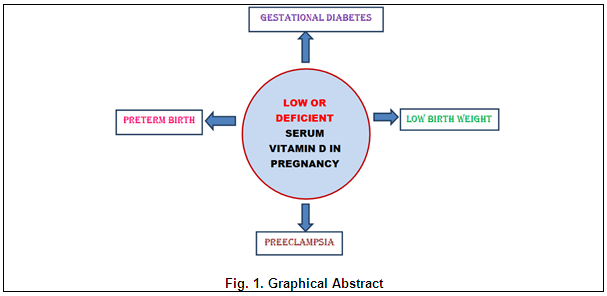
0.PNG

Keywords: Pregnancy, vitamin D, preeclampsia, gestational diabetes, preterm birth


How to Cite

Sonuga, Ayobola A., Oyebola O. Sonuga, Oluwagbenga A. Oyeyemi, and Ayokunle D. Makanjuola. 2022. “Hypovitaminosis D in Pregnancy: Implication for the Risk of Development of Pregnancy Complications”. International Journal of Research and Reports in Gynaecology 5 (1):285-95. https://journalijrrgy.com/index.php/IJRRGY/article/view/72.

Downloads

Download data is not yet available.

References

Jeon SM, Shin EA. Exploring vitamin D metabolism and function in cancer. Exp Mol Med. 2018;50(4):1-14.

DOI: 10.1038/s12276-018-0038-9

Tiwari A, Singh G, Singh U, Sapra L, Rana V, Sharma V, et al. Edible mushrooms: the potential game changer in alleviating vitamin D deficiency and improving human health. Int J Food Sci Technol. 2022; 57(3):1367-77.

DOI: 10.1111/ijfs.15410

Wacker M, Holick MF. Sunlight and vitamin D: A global perspective for health. Dermatoendocrinol. 2013;5(1):51-108.

DOI: 10.4161/derm.24494, PMID 24494042.

Gallagher JC. Vitamin D and aging. Endocrinol Metab Clin North Am. 2013;42(2):319-32.

DOI: 10.1016/j.ecl.2013.02.004, PMID 23702404.

Ross AC, Taylor CL, Yaktine AL, Del Valle HB. Dietary reference intakes for calcium and vitamin D. Washington, DC: National Academies Press; 2011.

Chen TC, Lu Z, Holick MF. Photobiology of vitamin D. In: Holick M, editor. Vitamin D: physiology, molecular biology, and clinical applications. 2nd ed. New York: Humana Press; 2010.

Bikle DD. Vitamin D metabolism, mechanism of action, and clinical applications. Chem Biol. 2014;21(3): 319-29.

DOI: 10.1016/j.chembiol.2013.12.016, PMID 24529992.

Sugimoto H, Shiro Y. Diversity and substrate specificity in the structures of steroidogenic cytochrome P450 enzymes. Biol Pharm Bull. 2012;35(6):818-23.

DOI: 10.1248/bpb.35.818, PMID 22687469.

Quraishi SA, Camargo CA. Vitamin D and major chronic illness. J Restor Med. 2012; 1(1):9-23.

DOI: 10.14200/jrm.2012.1.1001, PMID 30197839.

Girgis CM, Mokbel N, Cha KM, Houweling PJ, Abboud M, Fraser DR, et al. The vitamin D receptor (VDR) is expressed in skeletal muscle of male mice and modulates 25-hydroxyvitamin D (25OHD) uptake in myofibers. Endocrinology. 2014; 155(9):3227-37.

DOI: 10.1210/en.2014-1016, PMID 24949660.

Jones KS, Meadows SR, Schoenmakers I, Prentice A, Moore SE. Vitamin D status increases during pregnancy and in response to vitamin D supplementation in rural Gambian women. J Nutr. 2020;150(3):492-504.

DOI: 10.1093/jn/nxz290, PMID 31834380, PMCID PMC7056615.

Liu PT, Stenger S, Li H, Wenzel L, Tan BH, Krutzik SR, et al. Toll-like receptor triggering of a vitamin D-mediated humanantimicrobial response. Science. 2006;311(5768):1770-3.

DOI: 10.1126/science.1123933, PMID 16497887.

Cecil RL, Goldman L, Schafer AI. Goldman’s Cecil medicine. 24th ed. Philadelphia: Elsevier Saunders; 2012.

Sonuga AA, Sonuga OO. Hypovitaminosis D is associated with some metabolic indices in gestational diabetes mellitus. Biomed Hub. 2020;5(2):1177-90.

DOI: 10.1159/000508207, PMID 32884931, PMCID PMC7443670.

Tamblyn JA, Hewison M, Wagner CL, Bulmer JN, Kilby MD. Immunological role of vitamin D at the maternal–fetal interface. J Endocrinol. 2015;224(3):R107-21.

DOI: 10.1530/JOE-14-0642, PMID 25663707.

Janus A, Szahidewicz-Krupska E, Mazur G, Doroszko A. Insulin resistance and endothelial dysfunction constitute a common therapeutic target in cardiometabolic disorders. Mediators Inflamm. 2016;2016:3634948.

DOI: 10.1155/2016/3634948, PMID 27413253.

Etminan-Bakhsh M, Tadi S, Hatami M, Darabi R. Prevalence of gestational diabetes mellitus and its associated risk factors in boo-Ali Hospital, Tehran. Galen Med J. 2020;9:e1642.

DOI: 10.31661/gmj.v9i0.1642, PMID 34466559.

Committee on Practice Bulletins. Practice Bulletin No. 180. Practice Bulletin No. 180: Gestational Diabetes Mellitus. Obstet Gynecol. 2017;130(1):e17-37.

DOI: 10.1097/AOG.0000000000002159, PMID 28644336.

Mathieu IP, Song Y, Jagasia SM. Disparities in postpartum follow-up in women with gestational diabetes mellitus. Clin Diabetes. 2014;32(4):178-82.

DOI: 10.2337/diaclin.32.4.178, PMID 25646944.

Dror DK. Vitamin D status during pregnancy: maternal, fetal, and postnatal outcomes. Curr Opin Obstet Gynecol. 2011;23(6):422-6.

DOI: 10.1097/GCO.0b013e32834cb791, PMID 21986726.

Zuhur SShafi, Erol RS, Kuzu I, Altuntas Y. The relationship between low maternal serum 25-hydroxyvitamin D levels and gestational diabetes mellitus according to the severity of 25-hydroxyvitamin D deficiency. Clinics (Sao Paulo). 2013; 68(5):658-64.

DOI: 10.6061/clinics/2013(05)13, PMID 23778416.

Naznin F, Jesmin S, Akter N, Sharmin S, Khatun MR. Vitamin D status in patients of gestational diabetes mellitus in comparison to that of normal pregnancy. Ibrahim Card Med J. 2021;11(1):41-7.

DOI: 10.3329/icmj.v11i1.58704.

Jain M, Kapry S, Jain S, Singh SK, Singh TB. Maternal vitamin D deficiency: A risk factor for gestational diabetes mellitus in North India. Gynecol Obstet (Sunnyvale). 2015;5:264.

DOI: 10.4172/2161-0932.1000264.

Upreti V, Maitri V, Dhull P, Handa A, Prakash MS, Behl A. Effect of oral vitamin D supplementation on glycemic control in patients with type 2 diabetes mellitus with coexisting hypovitaminosis D: A parallel group placebo controlled randomized controlled pilot study. Diabetes Metab Syndr. 2018, Jul;12(4):509-12.

DOI: 10.1016/j.dsx.2018.03.008, PMID 29580871.

Yousefi Rad E, Djalali M, Koohdani F, Saboor-Yaraghi AA, Eshraghian MR, Javanbakht MH, et al. The effects of vitamin D supplementation on glucose control and insulin resistance in patients with diabetes type 2: a randomized clinical trial study. Iran J Public Health. 2014; 43(12):1651-6. PMID 26171357.

Maestro B, Campión J, Dávila N, Calle C. Stimulation by 1,25-dihydroxyvitamin D3 of insulin receptor expression and insulin responsiveness for glucose transport in U-937 human promonocytic cells. Endocr J. 2000;47(4):383-91.

DOI: 10.1507/endocrj.47.383, PMID 11075718.

Dzik KP, Kaczor JJ. Mechanisms of vitamin D on skeletal muscle function: oxidative stress, energy metabolism and anabolic state. Eur J Appl Physiol. 2019; 119(4):825-39.

DOI: 10.1007/s00421-019-04104-x, PMID 30830277.

Dunlop TW, Väisänen S, Frank C, Molnár F, Sinkkonen L, Carlberg C. The human peroxisome proliferator-activated receptor δ gene is a primary target of 1α,25-dihydroxyvitamin D3 and its nuclear receptor. J Mol Biol. 2005;349(2): 248-60.

DOI: 10.1016/j.jmb.2005.03.060, PMID 15890193.

The Task Force on Hypertension in Pregnancy. ACOG. Hypertens Preg; 2013.

Report of the National High Blood Pressure Education Program Working Group on High Blood Pressure in Pregnancy. National High Blood Pressure Education Program Working Group. Am J Obstet Gynecol. 2000;183:0.

Steegers EAP, von Dadelszen P, Duvekot JJ, Pijnenborg R. Pre-eclampsia. Lancet. 2010;376(9741):631-44.

DOI: 10.1016/S0140-6736(10)60279-6, PMID 20598363.

Al-Jameil N, Aziz Khan F, Fareed Khan M, Tabassum H. A brief overview of preeclampsia. J Clin Med Res. 2014;6(1):1-7.

DOI: 10.4021/jocmr1682w, PMID 24400024.

McElwain CJ, Tuboly E, McCarthy FP, McCarthy CM. Mechanisms of endothelial dysfunction in pre-eclampsia and gestational diabetes mellitus: Windows into future cardiometabolic health? Front Endocrinol (Lausanne). 2020 Sep 11;11:655.

DOI: 10.3389/fendo.2020.00655, PMID 33042016, PMCID PMC7516342.

Gathiram P, Moodley J. Pre-eclampsia: its pathogenesis and pathophysiolgy. Cardiovasc J Afr. 2016;27(2):71-8.

DOI: 10.5830/CVJA-2016-009, PMID 27213853, PMCID PMC4928171.

Sonuga AA, Asaolu MF, Oyeyemi AO, Oyeboloa OO. Effects of vitamin D3 supplementation on antioxidant status and lipid peroxidation product in preeclamptic women. J Gynecol. 2019;4(1): 000169.

Fischer D, Schroer A, Lüdders D, Cordes T, Bücker B, Reichrath J et al. Metabolism of vitamin D3 in the placental tissue of normal and pre-eclampsia complicated pregnancies and premature births. Clin Exp Obstet Gynecol. 2007;34(2):80-4. PMID 17629157.

Fogacci S, Fogacci F, Banach M, Michos ED, Hernandez AV, Lip GYH, et al. Vitamin D supplementation and incident preeclampsia: A systematic review and meta-analysis of randomized clinical trials. Clin Nutr. 2020;39(6):1742-52,ISSN 0261-5614.

DOI: 10.1016/j.clnu.2019.08.015, PMID 31526611.

Hu KL, Zhang CX, Chen P, Zhang D, Hunt S. Vitamin D levels in early and middle pregnancy and preeclampsia, a systematic review and metaanalysis. Nutrients. 2022;14(5):999.

DOI: 10.3390/nu14050999, PMID 35267975.

Saraf R, Morton SM, Camargo CA Jr., Grant CC. Global summary of maternal and newborn vitamin D status—a systematic review. Matern Child Nutr. 2016;12(4):647-68.

DOI: 10.1111/mcn.12210, PMID 26373311.

Poniedziałek-Czajkowska E, Mierzyński R. Could vitamin D be effective in prevention of preeclampsia? Nutrients. 2021 Oct 28;13(11):3854.

DOI: 10.3390/nu13113854, PMID 34836111.

Liu NQ, Hewison M. Vitamin D, the placenta and pregnancy. Arch Biochem Biophys. 2012;523(1):37-47.

DOI: 10.1016/j.abb.2011.11.018, PMID 22155151.

Díaz L, Noyola-Martínez N, Barrera D, Hernández G, Avila E, Halhali A, et al. Calcitriol inhibits TNF-alpha-induced inflammatory cytokines in human trophoblasts. J Reprod Immunol. 2009; 81(1):17-24.

DOI: 10.1016/j.jri.2009.02.005, PMID 19501915.

McDonald SD, Malinowski A, Zhou Q, Yusuf S, Devereaux PJ. Cardiovascular sequelae of preeclampsia/eclampsia: a systematic review and meta-analyses. Am Heart J. 2008;156(5):918-30.

DOI: 10.1016/j.ahj.2008.06.042, PMID 19061708.

Ganguly A, Tamblyn JA, Finn-Sell S, Chan SY, Westwood M, Gupta J et al. Vitamin D, the placenta and early pregnancy: effects on trophoblast function. J Endocrinol. 2018;236(2):R93-R103.

DOI: 10.1530/JOE-17-0491, PMID 29109081.

Li X, Zhou J, Fang M, Yu B. Pregnancy immune tolerance at the maternal-fetal interface. Int Rev Immunol. 2020;39(6):247-63.

DOI: 10.1080/08830185.2020.1777292, PMID 32530719.

Høyer-Hansen M, Nordbrandt SPS, Jäättelä M. Autophagy as a basis for the health-promoting effects of vitamin D. Trends Mol Med. 2010;16(7):295-302.

DOI: 10.1016/j.molmed.2010.04.005, PMID 20488750.

Kim HA, Perrelli A, Ragni A, Retta F, De Silva TM, Sobey CG, et al. Vitamin D deficiency and the risk of cerebrovascular disease. Antioxidants (Basel). 2020; 9(4):327.

DOI: 10.3390/antiox9040327, PMID 32316584.

Novakovic B, Sibson M, Ng HK, Manuelpillai U, Rakyan V, Down T, et al. Placenta-specific methylation of the vitamin D 24-hydroxylase gene: implications for feedback autoregulation of active vitamin D levels at the fetomaternal interface. J Biol Chem. 2009;284(22): 14838-48.

DOI: 10.1074/jbc.M809542200, PMID 19237542.

Division of Reproductive Health, National Center for Chronic Disease Prevention and Health Promotion. Preterm birth; 2020.

Oluwole AA, Okunade KS, Okojie OE. Maternal serum vitamin D levels and preterm delivery among low-risk parturients in Lagos, Nigeria. Int J Gynaecol Obstet. 2019;144(2):216-20.

DOI: 10.1002/ijgo.12719, PMID 30461011.

Singh D, Hariharan D, Bhaumik D. Role of vitamin D in reducing the risk of preterm labour. Int J Reprod Contracept Obstet Gynecol. 2015;4(1):86-93, ISSN 2320-1789.

DOI: 10.5455/2320-1770.ijrcog20150217.

World Health Organization. international statistical classification of diseases and related health problems. 10th revision. 2010;ICD-10.

Amegah AK, Nsoh M, Ashley-Amegah G, Anaman-Togbor J. What factors influences dietary and non-dietary vitamin D intake among pregnant women in an African population? Nutrition. 2018;50:36-44.

DOI: 10.1016/j.nut.2017.11.003, PMID 29522981.

Shakiba M, Iranmanesh MR. Vitamin D requirement in pregnancy to prevent deficiency in neonates: a randomised trial. Singapore Med J. 2013;54(5):285-8.

DOI: 10.11622/smedj.2013110, PMID 23716156.

Wagner CL, Baggerly C, McDonnell S, Baggerly KA, French CB, Baggerly L, et al. Post-hoc analysis of vitamin D status and reduced risk of preterm birth in two vitamin D pregnancy cohorts compared with South Carolina March of Dimes 2009-2011 rates. J Steroid Biochem Mol Biol. 2016;155(B):245-51.

DOI: 10.1016/j.jsbmb.2015.10.022, PMID 26554936.

Qin LL, Lu FG, Yang SH, Xu HL, Luo BA. Does maternal vitamin D deficiency increase the risk of preterm birth: A meta-analysis of observational studies. Nutrients. 2016;8(5):301.

DOI: 10.3390/nu8050301, PMID 27213444.

Tribe RM. Regulation of human myometrial contractility during pregnancy and labour: are calcium homeostatic pathways important? Exp Physiol. 2001;86(2): 247-54.

DOI: 10.1113/eph8602180, PMID 11429641.

Chesney RW. Vitamin D and the Magic Mountain: the anti-infectious role of the vitamin. J Pediatr. 2010;156(5): 698-703.

DOI: 10.1016/j.jpeds.2010.02.002, PMID 20385316.

Maugeri A, Barchitta M, Blanco I, Agodi A. Effects of vitamin D supplementation during pregnancy on birth size: A systematic review and meta-analysis of randomized controlled trials. Nutrients. 2019 Feb;11(2):442.

DOI: 10.3390/nu11020442, PMID 30791641.

Maugeri A, Barchitta M, Blanco I, Agodi A. Effects of vitamin D supplementation during pregnancy on birth size: A systematic review and meta-analysis of randomized controlled trials. Nutrients. 2019 Feb 20;11(2):442.

DOI: 10.3390/nu11020442, PMID 30791641, PMCID PMC6412248.

Liu NQ, Ouyang Y, Bulut Y, Lagishetty V, Chan SY, Hollis BW, et al. Dietary vitamin D restriction in pregnant female mice is associated with maternal hypertension and altered placental and fetal development. Endocrinology. 2013; 154(7):2270-80.

DOI: 10.1210/en.2012-2270, PMID 23677931.

Wei SQ, Audibert F, Luo ZC, Nuyt AM, Masse B, Julien P, et al. Maternal plasma 25-hydroxyvitamin D levels, angiogenic factors, and preeclampsia. Am J Obstet Gynecol. 2013;208(5):390:e1-6.

DOI: 10.1016/j.ajog.2013.03.025, PMID 23618499.

Karras SN, Fakhoury H, Muscogiuri G, Grant WB, van den Ouweland JM, Colao AM et al. Maternal vitamin D levels during pregnancy and neonatal health: Evidence to date and clinical implications. Ther Adv Musculoskelet Dis. 2016 Aug;8(4): 124-35.

DOI: 10.1177/1759720X16656810, PMID 27493691.

Kaur J, Kamboj K, Yadav AK, Kaur P, Kumar V, Jha V. Cholecalciferol supplementation and angiogenic markers in chronic kidney disease. PLOS ONE. 2022;17(6):e0268946.

DOI: 10.1371/journal.pone.0268946, PMID 35657784.

McDonnell SL, Baggerly KA, Baggerly CA, Aliano JL, French CB, Baggerly LL, et al. Maternal 25(OH)D concentrations ≥40 ng/mL associated with 60% lower preterm birth risk among general obstetrical patients at an urban medical center. PLOS ONE. 2017;12(7):e0180483.

DOI: 10.1371/journal.pone.0180483, PMID 28738090.

Purswani JM, Gala P, Dwarkanath P, Larkin HM, Kurpad A, Mehta S. The role of vitamin D in pre-eclampsia: a systematic review. BMC Preg Childbirth. 2017; 17(1):231.

DOI: 10.1186/s12884-017-1408-3, PMID 28709403.